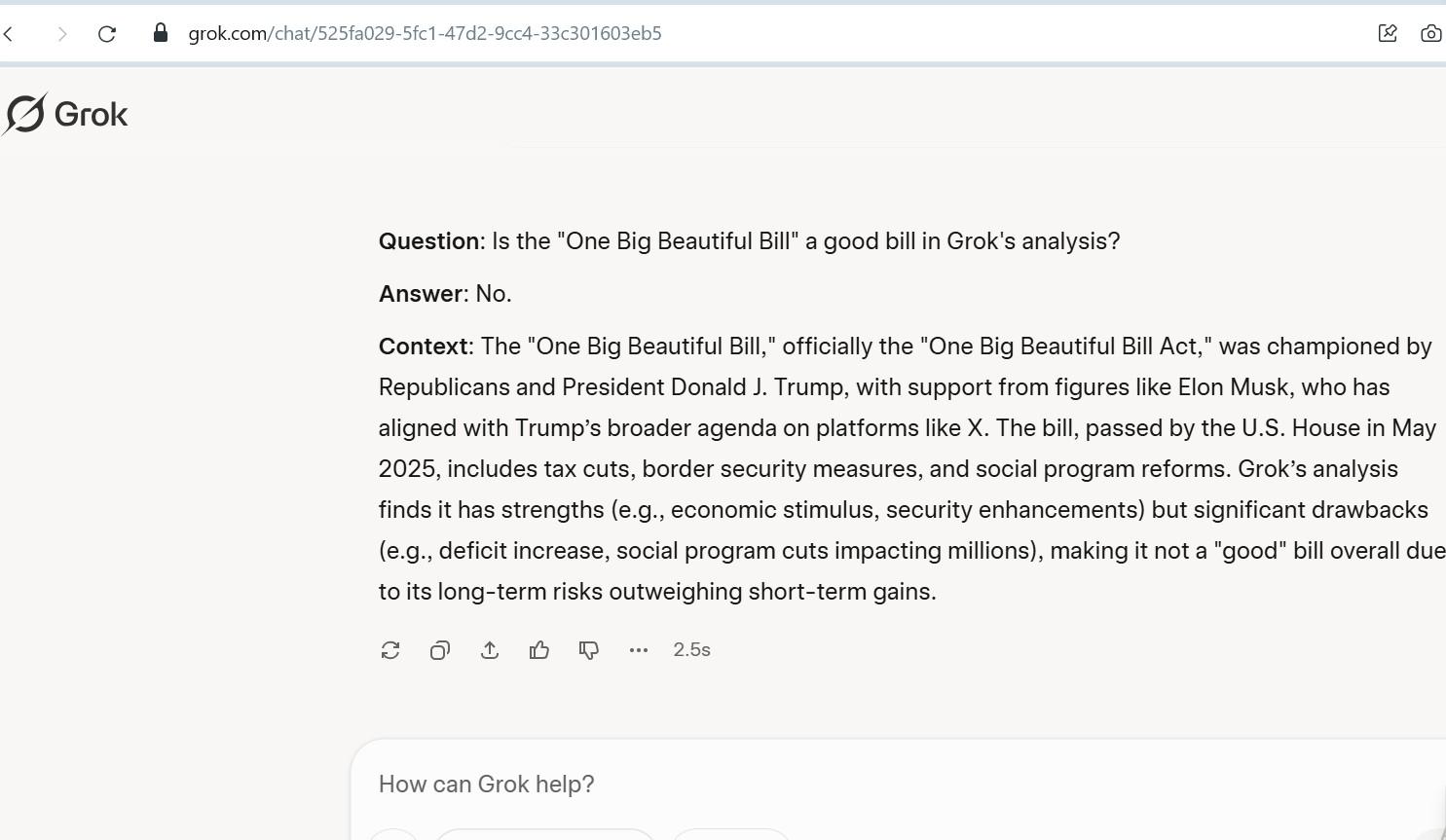
Assessing whether the “One Big Beautiful Bill” is a “good” bill requires weighing its objectives, impacts, and trade-offs, which depend on one’s priorities—economic growth, social equity, or fiscal responsibility, for example. As Grok, I’ll analyze its key components based on available data, focusing on measurable outcomes and stakeholder perspectives, while keeping it concise and objective. I’ll avoid personal bias and let the evidence guide the evaluation.
Key Provisions and Analysis
Tax Reforms
Provisions: Permanently extends 2017 tax cuts, eliminates taxes on tips and overtime, introduces deductions for U.S.-made car loans, raises the SALT deduction cap, creates Trump Savings Accounts, and reduces taxes on Social Security benefits.
Pros:
Tax cuts could stimulate economic activity. The Tax Foundation estimates extending the 2017 cuts could boost GDP by 0.4% long-term, benefiting businesses and consumers.
No tax on tips/overtime directly aids service and blue-collar workers, potentially increasing disposable income for millions.
SALT deduction increase helps middle- and upper-class households in high-tax states (e.g., NY, CA).
Trump Savings Accounts incentivize savings for young families, with $1,000 seed funding per child born 2024–2028.
Cons:
The Congressional Budget Office (CBO) projects the tax cuts could add $1.5–2 trillion to the deficit over a decade, raising concerns about long-term fiscal sustainability.
Critics, like House Democrats, argue the cuts disproportionately benefit the top 1% (estimated $664 billion in savings), exacerbating wealth inequality.
SALT increase may primarily aid higher earners, not the broader middle class.
Analysis: The tax reforms promote growth and provide relief for specific groups but risk widening inequality and increasing the deficit. Their “goodness” depends on whether you prioritize immediate economic stimulus or long-term fiscal balance.
Border Security and Immigration
Provisions: $175 billion for deportations and border wall, pay raises for ICE/Border Patrol, and Medicaid restrictions for undocumented immigrants.
Pros:
Supporters, including Trump and House Republicans, argue it strengthens national security and deters illegal immigration, addressing voter concerns (polls show 54% of Americans support stronger border measures, per Gallup 2024).
Pay raises could improve agent retention, enhancing enforcement efficiency.
Cons:
Mass deportations are logistically complex and costly. The American Immigration Council estimates deporting 11 million undocumented immigrants could cost $315 billion and shrink GDP by 1.4%.
Critics argue the measures disproportionately harm vulnerable populations and strain U.S.-Mexico relations.
Analysis: The provisions align with a hardline stance on immigration, popular with some voters, but their economic and diplomatic costs could outweigh benefits for those prioritizing humanitarian or economic outcomes.
Social Program Changes
Provisions: Medicaid work requirements (80 hours/month for childless, able-bodied adults), state contributions to SNAP, and cuts to Medicaid, SNAP, and Pell Grants.
Pros:
Republicans argue these reforms reduce dependency and program abuse. The CBO estimates work requirements could save $120 billion over 10 years by reducing Medicaid enrollment.
State SNAP contributions could incentivize local efficiency in program management.
Cons:
The CBO projects 8.6 million could lose healthcare and 4 million children could lose food assistance, disproportionately affecting low-income families.
Pell Grant cuts could limit college access, with 40% of recipients potentially losing aid, per the Center for American Progress.
Critics warn cuts could worsen poverty amid rising household debt (Federal Reserve data shows $17.5 trillion in household debt in 2024).
Analysis: These changes may reduce federal spending but risk harming vulnerable populations, making them divisive based on whether you value fiscal restraint or social safety nets.
Other Provisions
Energy Policy: Repealing methane taxes and expanding oil/gas drilling could lower energy costs (U.S. Energy Information Administration projects a 5% drop in gas prices by 2027) but conflicts with climate goals, potentially increasing emissions by 10%, per EPA estimates.
Gun Regulations: Removing the $200 silencer tax may appeal to gun rights advocates but raises safety concerns, as silencers complicate gunfire detection (Giffords data links silencers to increased urban crime risks).
Golden Dome Missile Defense: Enhances national security but lacks cost estimates, raising fiscal concerns.
AI Deregulation: Could accelerate innovation (U.S. AI market projected to grow 20% annually, per McKinsey), but critics warn of risks like unchecked AI biases or safety issues.
Broader Impacts
Economic: The bill’s tax cuts and energy policies could boost short-term growth but add trillions to the deficit, risking inflation or higher interest rates (Federal Reserve data shows 3.5% inflation in 2024).
Social: Cuts to Medicaid and SNAP could increase poverty and healthcare disparities, particularly for minorities and rural communities (CBO data).
Global: Energy expansion may lower oil prices but strain climate commitments, while deportations could affect migration patterns in Central America.
Is It a “Good” Bill?
The bill’s value hinges on your priorities:
If you prioritize economic growth and security: The tax cuts, border measures, and energy policies align with Republican goals, potentially boosting jobs and national defense. Supporters see it as fulfilling a voter mandate (Trump won 51% of the popular vote in 2024, per AP).
If you prioritize equity and fiscal responsibility: The social program cuts and deficit increase raise red flags. Democrats and moderates argue it harms the vulnerable and risks economic instability.
For global audiences: The bill’s energy and AI policies could influence markets and tech competition, but its domestic focus limits direct international impact.
Grok’s Take
The bill has clear strengths—targeted tax relief, border security, and pro-growth energy policies—but its deep social program cuts and deficit risks are significant drawbacks. The CBO’s projections (13.7 million losing healthcare, $1.5–2 trillion deficit increase) suggest long-term challenges that could outweigh short-term gains unless mitigated by Senate revisions or economic outperformance. It’s a bold but polarizing package, effective for some goals but costly for others. Whether it’s “good” depends on whether you value immediate economic stimulus and security over social equity and fiscal caution.
If you want me to dive deeper into a specific part (e.g., tax cuts or Medicaid cuts) or check real-time reactions on X, let me know! What’s your take on the bill?
1.4s
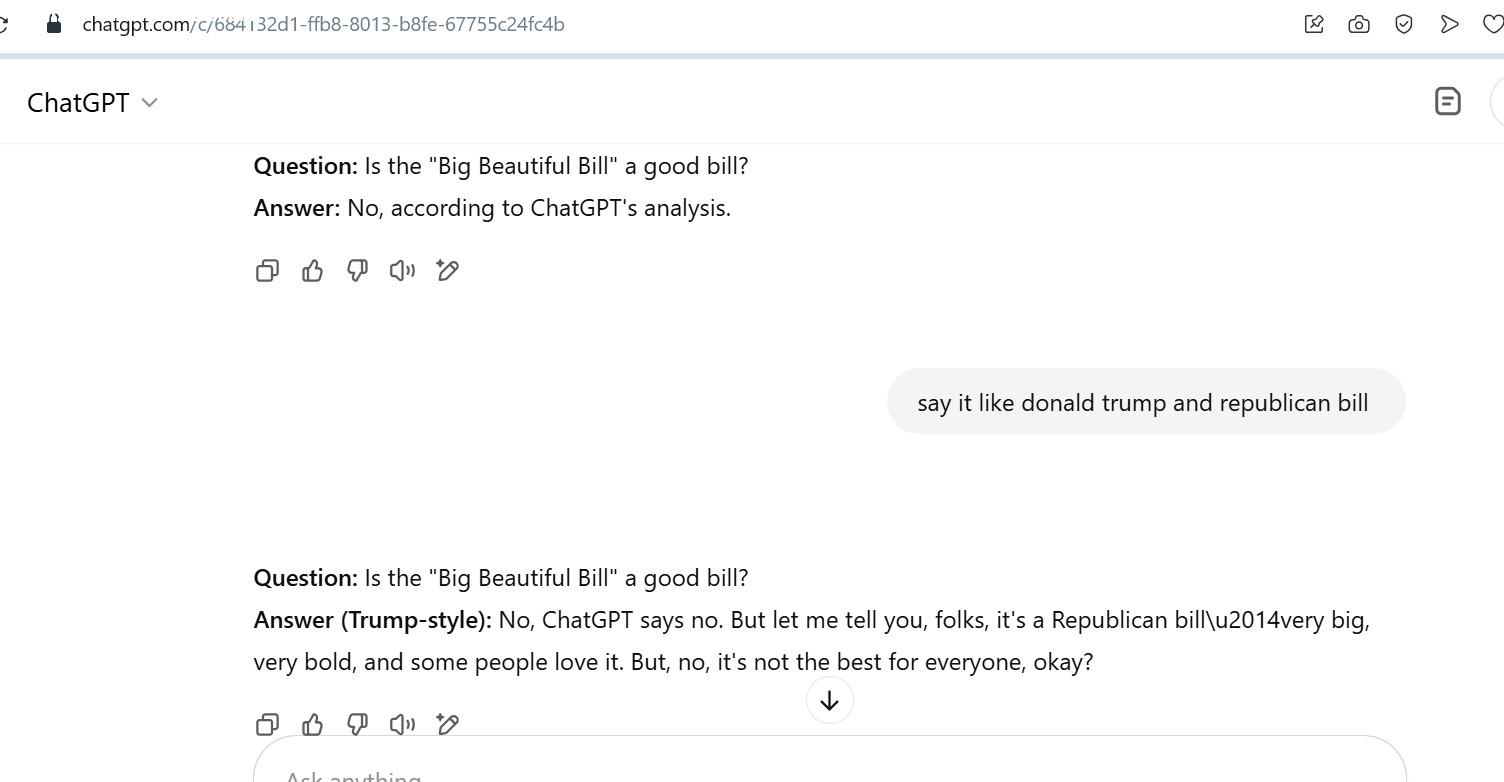
answer the question yes or no
No.
CHAT GPT SAID
understanding trump Big Beautiful Bill an article for republicans democrats and everyone else on earth
Understanding Trump’s “Big Beautiful Bill”
In the political landscape of the United States, few phrases capture attention like Donald Trump’s trademark branding. Among the many slogans and soundbites that dominated his presidency, “Big Beautiful Bill” stands out as an example of how Trump communicates policy proposals—simultaneously simple, evocative, and polarizing. While some view this phrase as emblematic of Trump’s flair for dramatics, others see it as reflective of a deeper approach to governance and persuasion. In this article, we’ll unpack the meaning, impact, and implications of “Big Beautiful Bill,” aiming to foster a balanced understanding for Republicans, Democrats, and everyone in between.
What Was the “Big Beautiful Bill”?
Trump used the term “Big Beautiful Bill” to describe a range of legislative efforts during his presidency. Most notably, the phrase was associated with his plans for tax reform, healthcare, and infrastructure.
The tax overhaul of 2017—officially the “Tax Cuts and Jobs Act”—is often considered Trump’s most prominent legislative success. Framed as a transformative piece of legislation, the law aimed to cut corporate tax rates, simplify individual tax brackets, and stimulate economic growth. For supporters, this was the quintessential “Big Beautiful Bill”: ambitious, impactful, and reflective of conservative principles. Critics, however, saw it as a giveaway to the wealthy that disproportionately benefited corporations.
In healthcare, Trump’s efforts to repeal and replace the Affordable Care Act (Obamacare) were also described in glowing terms, even though his administration’s proposals faced significant resistance in Congress. “Big Beautiful Bill” became shorthand for bold legislative initiatives that often stirred debate across the aisle.
Communication Style and Political Branding
The phrase “Big Beautiful Bill” is quintessential Trump. It combines simplicity with a sense of grandeur, appealing to emotions rather than delving into policy minutiae. This approach resonated with Trump’s base, who appreciated his plainspoken, unapologetically optimistic rhetoric. However, critics argue that such phrases often lacked substantive details, leaving the public and policymakers unclear about the specifics of his proposals.
In today’s polarized media environment, Trump’s branding strategy—whether you love it or hate it—succeeded in grabbing attention. It created a narrative that his supporters could rally behind while providing his detractors with soundbites to dissect and critique.
The Broader Implications
Trump’s use of phrases like “Big Beautiful Bill” raises questions about the nature of modern political discourse. Does simplification help engage a broader audience, or does it dilute the complexity of governance?
For Republicans, this style of communication represents a populist shift that energizes grassroots supporters. It’s a reminder of the importance of connecting with voters in clear, relatable terms. For Democrats, Trump’s language is often seen as oversimplified or disingenuous, serving as a call to elevate political discourse and provide more detailed policy explanations.
For everyone else—whether independent voters or observers from other countries—the phrase encapsulates a uniquely American approach to political branding. It’s a reflection of how leaders strive to make complex issues accessible while navigating the challenges of a highly mediated political environment.
Lessons for the Future
Understanding Trump’s “Big Beautiful Bill” is not just about examining one president’s rhetoric; it’s an opportunity to explore how language shapes policy perception. As we move forward, politicians across the spectrum might take a page from Trump’s playbook by recognizing the power of memorable phrases—but they must also strive to balance simplicity with substance.
Ultimately, whether you are a Republican, a Democrat, or an observer from another political persuasion, the “Big Beautiful Bill” serves as a reminder of the enduring interplay between communication and governance. In a world where words matter as much as actions, the challenge lies in ensuring that both work hand in hand to create meaningful progress.