 Written by
 In a quiet laboratory north of Moscow, a physicist named Dr. Eugene Podkletnov may have done the unthinkable: aimed gravity like a beam—and fired it.
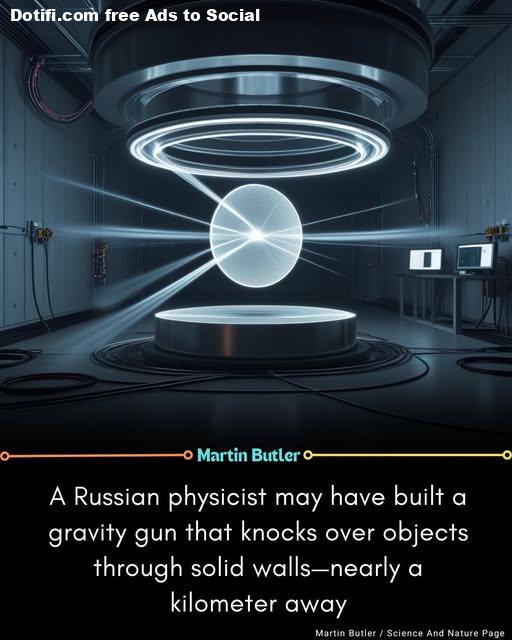
Using a spinning superconducting disc inside a high-voltage discharge chamber, Podkletnov claims to have created a “gravitational impulse”—a directed burst of force that penetrates walls, floors, and barriers with no detectable loss of energy. According to his reports, this impulse was strong enough to knock over objects nearly a kilometer away.
If true, this would represent the first ever demonstration of a gravity-based propulsion system—and a complete rewriting of physics as we know it.
While mainstream science has long been skeptical of Podkletnov’s work, whispers of interest persist in high places. Leaked documents and quiet citations suggest that NASA and defense agencies have not only studied his papers but attempted replication. In 2001, a NASA Marshall Space Flight Center document acknowledged Podkletnov’s gravity beam experiments, noting the potential for “field propulsion” in spacecraft.
Here’s why that matters.
Traditional rockets use combustion or ion thrusters, which are limited by fuel mass and exhaust velocity. But a directed gravitational impulse would need no fuel—just energy. If gravity can be emitted and aimed like a wave or pulse, the implications are staggering:
Spaceships could “push off” empty space.
Communication could bypass electromagnetic interference.
Undetectable energy weapons might one day use gravity itself.
Podkletnov’s gravity beam reportedly does not emit heat, radiation, or magnetic fields—only a sudden, sharp force that affects only mass, and nothing else. It’s as if spacetime is being squeezed in a brief, localized burst. The effect isn’t blocked by barriers. It simply passes through.
Skeptics argue that the mechanism violates general relativity, or at least bends its limits beyond what’s been confirmed. But that’s the nature of the frontier. Every major leap—radio, nuclear power, quantum entanglement—began as an outlier.
Whether Podkletnov’s experiment holds up under scrutiny or not, it raises a deeper question: What is gravity, really? A warping of spacetime? A quantum field? Or something we’ve only begun to glimpse?
If gravity can be focused, the door to field-based technology—propulsion, shielding, even terraforming—swings wide open.
And the moment we learn to aim gravity like a laser… the age of fuel may end forever.